Every child enters a classroom carrying questions far greater than the curriculum can answer. How do I solve problems no one has solved before? How do I adapt to a world that changes faster than textbooks can be rewritten? How do I create value in professions that do not yet exist? The future will not reward those who simply remember information; it will belong to those who can connect ideas, embrace uncertainty, think critically, and transform knowledge into meaningful action.
Preparing young minds for that future demands more than introducing new technologies into classrooms. It requires reimagining the very purpose of education. Learning must move beyond memorising concepts to cultivating curiosity, creativity, resilience, ethical thinking, and the confidence to ask better questions. Schools must become places where innovation is practised, not merely discussed; where artificial intelligence becomes a tool for responsible problem-solving; and where every student is encouraged to become not just a learner, but a creator of solutions.
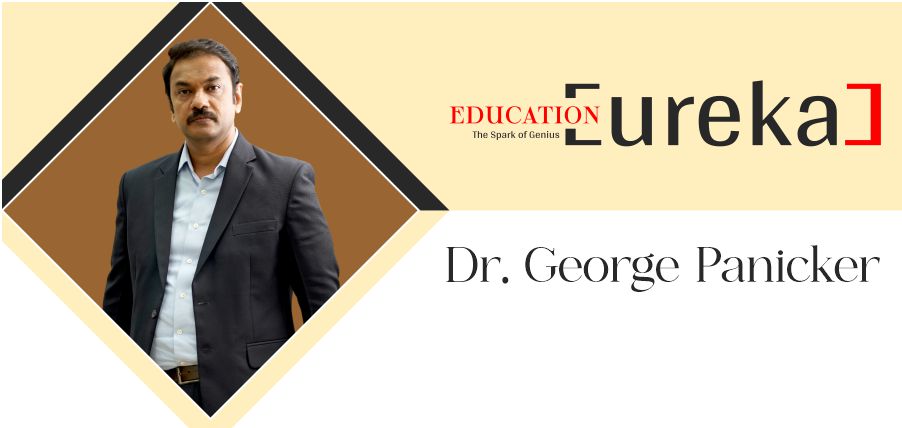
This belief lies at the heart of Dr. George Panicker’s vision. As the Founder and CEO of International STEAM Research (ISR), he has dedicated his work to helping schools prepare students for a future defined by constant transformation. His philosophy is built on a simple yet powerful conviction: education should not merely prepare children for examinations; it should prepare them for life.
Transforming Adversity into Opportunity
Launching an educational enterprise during a global pandemic demanded extraordinary conviction. Schools were struggling to maintain continuity, educators were adapting overnight to digital teaching, and uncertainty overshadowed every aspect of learning. Conventional wisdom suggested postponing ambitious ventures until stability returned.
Dr. Panicker saw the situation differently.
Rather than viewing the pandemic solely as a crisis, he recognised it as a powerful reminder that traditional education systems required fundamental change. The rapid shift to online learning exposed longstanding challenges that extended well beyond technology. Rote memorisation, inflexible curricula, and examination-driven approaches were no longer sufficient for preparing young people to navigate an increasingly complex and unpredictable world.
Driven by decades of experience in education, innovation, and technology, he established ISR with a clear purpose: to help schools create environments where students develop not only academic competence but also the confidence, creativity, and adaptability needed to solve real-world problems.
This vision placed artificial intelligence and STEAM education at the heart of learning, not as isolated subjects but as interconnected tools that encourage analytical thinking, collaboration, ethical reasoning, and innovation. By integrating these disciplines into everyday education, ISR enables students to become active creators of knowledge rather than passive recipients of information.
The organisation’s remarkable growth since its inception reflects the relevance of this vision. Within only a few years, ISR has established itself as one of India’s most respected AI-STEAM education organisations, partnering with schools to cultivate future-ready learners equipped for a rapidly changing world.
Redefining Excellence Through AI-STEAM Education
One of the defining characteristics of ISR is its commitment to making innovation meaningful rather than fashionable. While many educational initiatives introduce technology as an end in itself, Dr. Panicker believes technology should serve a much larger educational purpose.
Central to ISR’s philosophy is the concept of micro-excellence, the belief that extraordinary achievement is built through consistent, incremental improvement rather than occasional moments of brilliance. Instead of measuring success solely through grades or examination scores, students are encouraged to strengthen their abilities every day by exploring ideas, asking better questions, testing solutions, and reflecting on their learning.
This philosophy transforms classrooms into environments where curiosity is valued as highly as correctness. Students learn to approach challenges through investigation rather than memorisation, combining scientific thinking, engineering principles, creativity, mathematics, and emerging technologies to develop practical solutions for authentic problems.
Artificial intelligence plays an equally important role within this framework. Rather than teaching AI simply as another technical subject, ISR encourages learners to understand how intelligent technologies can be applied responsibly across diverse disciplines. Students engage with data, programming, automation, and ethical decision-making while developing the human qualities that machines cannot replace, creativity, empathy, collaboration, and critical thinking.
By balancing technological capability with human values, ISR prepares learners to participate confidently in an economy increasingly shaped by AI without losing sight of the social responsibility that accompanies innovation.
Connecting Education with the Future of Work
As industries evolve at unprecedented speed, the expectations placed upon graduates continue to change. Employers increasingly value adaptability, problem-solving, collaboration, communication, and digital fluency alongside technical expertise.
Recognising this shift, Dr. Panicker has consistently focused on reducing the long-standing disconnect between classroom learning and workplace realities.
ISR collaborates with industry experts, technology professionals, and educational institutions to understand emerging workforce requirements and translate them into meaningful learning experiences for students. Instead of treating education and industry as separate worlds, the organisation creates opportunities for students to apply academic concepts within practical contexts.
Learners investigate environmental challenges using artificial intelligence, develop engineering prototypes that address community needs, analyse real-world data, and examine ethical questions surrounding technology and digital responsibility. These experiences encourage students to think beyond textbooks while developing the confidence to solve unfamiliar problems.
This approach also nurtures entrepreneurial thinking. Students are encouraged not only to prepare for future careers but also to recognise opportunities to create value, develop innovative ideas, and contribute meaningfully to society.
For Dr. Panicker, preparing students for the future has never been limited to teaching technical skills. It is about developing individuals who remain curious throughout life, adapt confidently to change, and approach every challenge with resilience and purpose.
Empowering Those Who Shape Young Minds
While educational technology often dominates discussions about innovation, Dr. Panicker believes meaningful transformation begins with teachers.
From the earliest stages of ISR’s development, the organisation has rejected the notion that technology should replace educators. Instead, it views technology as a resource that strengthens teaching, providing educators with better tools, richer insights, and greater freedom to focus on what matters most: inspiring students.
Through comprehensive professional development programmes, ISR equips teachers with the confidence to integrate AI-STEAM learning into everyday classroom practice. Rather than introducing isolated technology lessons, educators learn to create interdisciplinary experiences that encourage exploration, creativity, and collaborative learning.
School leaders are similarly supported in building cultures where experimentation is encouraged, curiosity is celebrated, and continuous improvement becomes part of everyday practice.
The result extends far beyond improved academic outcomes. Schools adopting ISR’s approach often experience a broader cultural transformation. Classrooms become environments where students feel comfortable questioning assumptions, exploring alternative perspectives, learning from failure, and developing independent thought.
For Dr. Panicker, this shift represents one of education’s greatest responsibilities: creating learners who possess not only knowledge but also the confidence to apply it thoughtfully throughout their lives.
Advancing Education with Purpose and Responsibility
For Dr. George Panicker, preparing students for the future extends beyond equipping them with technical knowledge. Education, in his view, must cultivate responsible citizens who understand that innovation carries an obligation to improve lives and contribute positively to society.
This philosophy is deeply embedded within ISR’s educational framework through its alignment with the United Nations Sustainable Development Goals (SDGs). Rather than presenting sustainability, social responsibility, and ethical innovation as standalone topics, ISR integrates them into project-based learning experiences that encourage students to engage with challenges affecting both their communities and the wider world.
Students are encouraged to explore environmental issues using artificial intelligence and data analytics, design engineering solutions that improve accessibility and quality of life, and examine the ethical implications of emerging technologies. Through these experiences, learning becomes more than an academic exercise, it becomes an opportunity to understand how knowledge can create meaningful impact.
This emphasis on responsibility distinguishes ISR’s approach. While technological advancement remains central to its mission, equal importance is placed on empathy, inclusivity, collaboration, and ethical decision-making. Students learn not only how to develop innovative solutions but also why those solutions should serve people and communities.
For Dr. Panicker, the purpose of education has never been limited to preparing graduates for employment. It is about nurturing individuals who possess the wisdom to use their abilities for the greater good.
Building an Ecosystem of Educational Excellence
The rapid progress achieved by International STEAM Research reflects more than the strength of its educational programmes. It is the outcome of a collaborative ecosystem that brings together educators, researchers, technologists, industry experts, and school leaders with a shared commitment to transforming learning.
Under Dr. Panicker’s leadership, ISR has steadily expanded its influence across schools by providing research-driven frameworks, professional development programmes, curriculum innovation, and AI-STEAM integration tailored to the evolving needs of modern education.
The organisation’s work has attracted recognition from educators, policymakers, and industry leaders who view ISR as an example of how educational innovation can be implemented thoughtfully and sustainably. Invitations to contribute to conferences, leadership forums, and discussions surrounding educational reform further reflect the growing influence of both Dr. Panicker and the organisation he has built.
Recognition has also come through numerous awards honouring ISR’s contributions to education, innovation, and social impact. Yet Dr. Panicker consistently attributes these achievements to the collective efforts of his multidisciplinary team.
Researchers, curriculum specialists, engineers, educators, designers, technologists, and operational leaders have each played an important role in translating a shared vision into practical solutions that benefit schools across the country. This collaborative culture continues to define ISR’s success, reinforcing the belief that lasting transformation is never achieved by individuals alone but through teams united by purpose.
Leading India’s AI-STEAM Movement
India stands at a defining moment in its educational journey. As artificial intelligence reshapes industries and economies, the country’s future competitiveness will depend not only on technological advancement but also on its ability to cultivate learners who can think creatively, adapt continuously, and solve increasingly complex challenges.
Dr. George Panicker has positioned ISR at the forefront of this transformation.
Rather than viewing AI as simply another subject within the curriculum, he envisions it as a catalyst for reimagining how learning occurs across every discipline. His approach encourages students to connect knowledge, question assumptions, embrace experimentation, and approach problems from multiple perspectives.
Equally significant is his conviction that education must evolve alongside industry without losing its human foundation. Schools should prepare students for careers that may not yet exist while preserving the values of empathy, collaboration, ethical leadership, and social responsibility.
This balanced perspective has enabled ISR to emerge as one of India’s leading voices in AI-STEAM education. By combining technological innovation with educational research and practical implementation, the organisation continues to demonstrate that future-ready learning is not defined by sophisticated tools alone but by the ability to inspire curiosity, resilience, and lifelong growth.
For many schools, ISR has become more than an educational partner. It has become a catalyst for cultural change, encouraging institutions to move beyond traditional teaching models and embrace learning environments where creativity and innovation flourish alongside academic excellence.
A Vision That Continues to Shape the Future
A transformative change must start somewhere with a readiness to question the status quo. Dr. George Panicker made this clear by starting up International STEAM Research in what turned out to be one of the most uncertain times in recent years. Where once stood a bold reaction to an unprecedented global disruption now stands a revolution in how schools equip their students for tomorrow.
This personal story embodies a leadership mindset that is rooted in optimism, boldness, and conviction about the ability of education to make a difference. Through ISR, he has promoted an approach to learning that embraces curiosity not compliance, development not complacency, and innovation not just technology.
But probably the greatest thing he will be known for is his impact on how success is evaluated in education. Rather than looking at academic achievement, his vision of education is one that prepares students to be thinkers, innovators, collaborators, and responsible problem-solvers for society.
In a world where India is emerging as a leader in innovations and technology, organizations such as International STEAM Research will become even more influential in forming the country’s future intellectuals and workforce. Guided by Dr. Panicker, International STEAM Research shows us that real educational reforms can be reached when one commits to empowering schools, helping teachers and motivating students to unlock their full potential.
The tale of Dr. George Panicker teaches us that true leaders should not only create influential organizations, but also give people opportunities to develop and become leaders themselves. Through his work on rethinking the concept of AI-STEAM education based on innovations, research and purpose, Dr. Panicker is contributing to creating the future in which education will become the cornerstone of personal and collective achievements.
One of India’s Most Influential Business Leaders Shaping the Future in 2026
Dr. George Panicker, Founder & CEO, International STEAM Research (ISR)
“Artificial intelligence is transforming the world, but our greatest responsibility is to ensure it strengthens human intelligence, creativity, and compassion rather than replaces them.”
“Every classroom should be a place where innovation is experienced, not simply explained. Students learn best when they are encouraged to create, experiment, and solve real problems.”
“Future-ready education is not defined by the technology we introduce; it is defined by the confidence, adaptability, and character we cultivate in every learner.”