
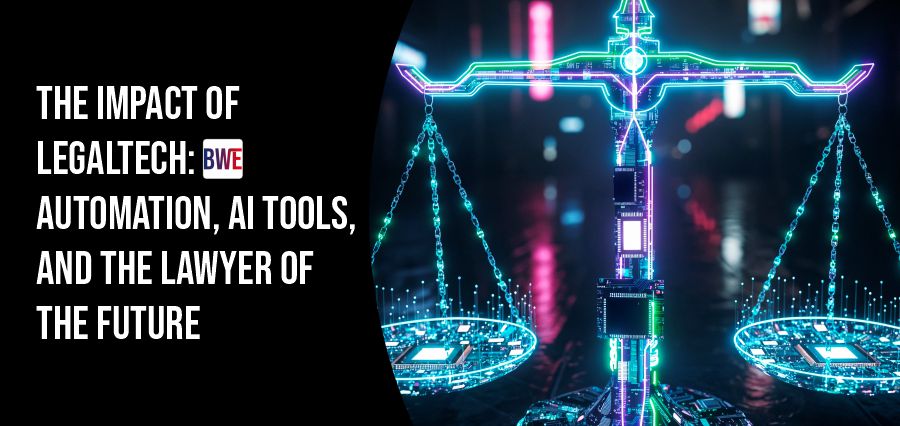
The legal profession has always been steeped in tradition. Lawyers pore over thick volumes of case law, painstakingly draft and review contracts, and slog through paperwork. But over the past decade, technology has begun to change that, and now, with the arrival of advanced automation and artificial intelligence (AI), the landscape of legal work is shifting dramatically. LegalTech is no longer a futuristic idea. It is here, reshaping how legal services are delivered and what it means to be a lawyer in the future.
LegalTech refers to the application of technology to provide, support, or improve legal services. This includes automation tools, AI-powered legal research software, contract-management platforms, online courts, document-management systems, e-filing, e-discovery, and more.
What matters is how these tools address the persistent inefficiencies in legal practice: time-consuming document review, slow contract processing, voluminous legal research, and administrative overhead. When handled well, LegalTech can deliver faster, cheaper, more accurate, and more accessible legal services.
AI and automation now handle many of the tasks that traditionally consumed vast amounts of lawyer time. Document review, e-discovery, contract analysis, legal research, and case-law searches, these can now be processed in minutes rather than hours or days.
Many legal teams and firms report that they can now manage greater workloads without proportionately increasing headcount.
AI-powered contract lifecycle management (CLM) platforms can extract terms, flag risky clauses, ensure compliance, and standardize contract language. This reduces human error and ensures consistency across documents, especially helpful for firms managing large volumes of agreements.
Instead of sifting manually through thousands of judgments and statutes, lawyers can now rely on AI to surface the most relevant precedents in seconds. This not only speeds research but also improves its depth and breadth.
Furthermore, predictive analytics and data-driven tools help assess likely case outcomes based on historical data, trends, and judicial behavior. That offers lawyers and clients better insight into risks and strategy.
By automating time-intensive tasks, firms reduce their reliance on junior associates or paralegals for routine work. That translates to cost savings, greater throughput, and the ability to take on more or larger matters.
For clients, this often means faster turnaround times and lower legal fees for standard services such as contract drafting, due diligence, or compliance.
AI tools tend to catch inconsistencies, missing clauses, typos, and compliance issues that humans might overlook, especially when under pressure or dealing with high volumes. That reduces risk for both lawyers and clients.
Consistent contract templates, standardized review workflows, and centralized document repositories also lead to better record-keeping and audit readiness.
With LegalTech, smaller firms and solo practitioners can access sophisticated tools previously available only to large firms. This levels the playing field and may make quality legal advice more accessible to more people.
For the justice system overall, the shift promises greater efficiency in case handling, better access to legal representation, and potentially faster dispute resolution.
Adopting AI and automation does not mean lawyers disappear. Ethical, privacy, and governance concerns remain. AI may process data quickly, but it does not possess the judgment, moral reasoning, or advocacy skill that human lawyers bring, especially in complex or sensitive cases.
There is also the question of bias and fairness. If AI is trained on incomplete or skewed data, it can reproduce inequality or erroneous legal reasoning.
Smaller firms may also struggle with the cost of implementing AI tools, training legal staff, and maintaining data security.
Finally, existing business models, especially those based on billable hours, need rethinking. If AI allows tasks to be finished faster, how will firms charge? What becomes the measure of value when speed and efficiency replace hours billed?
As LegalTech becomes mainstream, the role of the lawyer will evolve beyond paperwork and routine tasks. Here is what to expect for the lawyer of the future:
In short, future lawyers will be more like legal strategists, counselors, integrators of technology, and guardians of ethics and fairness.
LegalTech, particularly automation and AI, has already begun to transform the legal industry. What once took hours or days can now be done in minutes. Firms are delivering faster, more cost-effective service. Lawyers are freed to focus on strategy, client relations, and complex cases.
But this is not a substitution of humans by machines. LegalTech enhances the strengths of lawyers while tackling the drudgery of routine work. The promise of LegalTech lies in its ability to amplify human judgment, not replace it.
The legal profession stands at a crossroads. Firms and lawyers who embrace technology, while committing to ethical, fair, and secure use, stand to gain efficiency, relevance, and a chance to shape the future of justice. Their challenge is to strike the right balance: between speed and careful reasoning, between automation and human oversight, between cost-saving and quality.
Those who navigate wisely will become the lawyers of the future: informed by technology, empowered by efficiency, guided by ethics, and dedicated to justice.
Read Also – Rohit Jolly






Welcome to Business World Eureka, your premier destination for global business intelligence. We are a leading digital magazine platform, committed to delivering the latest business insights, trends, technologies, news and press releases from across the globe.
©Copyright at Business World Eureka 2025 | All Rights Reserved